
Header image: A spoon-billed sandpiper with breeding plumage being held in quarantine in Slimbridge
It’s summer in Chukotka, north-east Russia. Imagine you’re standing on a windblown shore near the tiny settlement of Meinypil’gyno. Grey whales blow in the surf and a bear ambles along a ridge. But what grabs your attention is a small bird scurrying across the tundra. It’s a newly fledged young wader, and, judging by that bizarre beak, not just any wader. That’s right, the youngster is a fledgling spoon-billed sandpiper.
This is great news and indisputable evidence of a critically endangered species breeding in its natural habitat. But it’s not quite the full story. This particular ‘spoonie’ had a head start in life, thanks to you, our supporters, our conservation partners and generous funding by Leica.
A helping hand
Things began naturally enough, with a clutch of eggs laid in a wild nest, but then our experts intervened. They took the eggs into captivity, incubated them to hatching, then hand-raised the chicks. Only once the chicks were ready to fend for themselves did we release them back into the wild. In an ideal world, we’d be able to just leave them alone and not take them away from sitting females, but when only a few hundred individuals of a species are left, this approach is too slow.
Meinypil’gyno is one of just a handful of breeding sites for the spoon-billed sandpiper and there are thought to be just over 200 pairs in total. This was mostly due to hunting and habitat damage on the species’ winter quarters in south-east Asia. To beat extinction the population must rise faster than nature can manage by itself, which is why we decided to lend a hand.
Ultimately, it all comes down to numbers. Studies have shown that, left alone, a single wild clutch of spoonies would result on average in 0.6 fledglings every year. With headstarting, however, the same clutch would produce on average 3.2 fledglings, thus allowing the population to grow more than five times faster. What’s more, the wild adults might also lay a second clutch. Interfering is risky but similar work in the USA with the related piping plover has been a success, so we believe it’s a risk worth taking. This kind of hands-on approach is known as ‘close-order management’.
It doesn’t mean abandoning more traditional approaches. With the spoonie, for instance, we’re also working to map the birds’ migration routes, protect their wintering grounds and build up a buffer population by captive breeding at WWT Slimbridge. However, these are long-term solutions.
This species is now so close to the brink that, without speedier action, it may not have a long term. ‘We know headstarting alone won’t solve the problem,’ says our Head of Conservation Science, Geoff Hilton. ‘But first we need more birds – to buy ourselves time.’
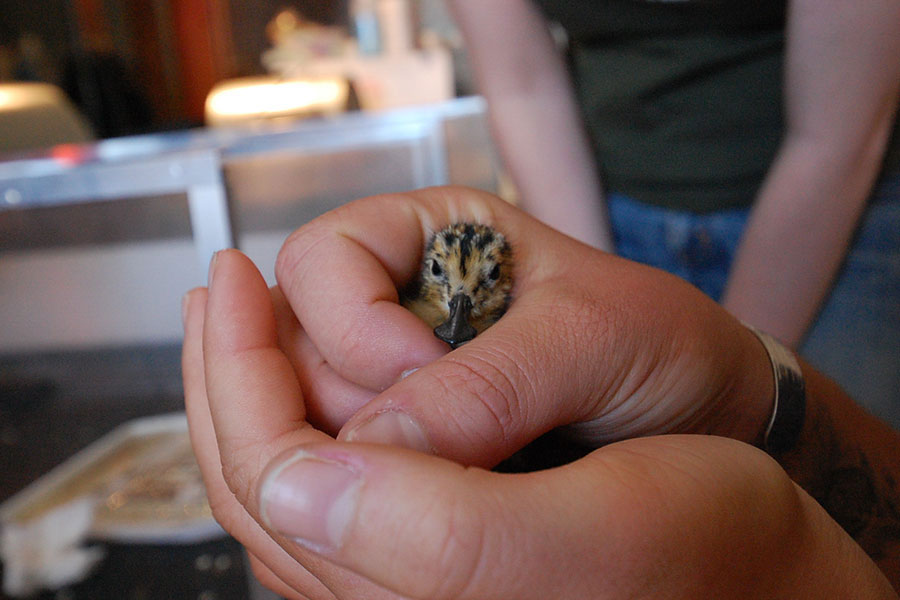 A spoon-billed sandpiper chick is given a headstart
Daring rescue missions
There are numerous examples of such daring last-ditch actions, often driven by maverick individuals. In 1980, Don Merton took drastic steps to save New Zealand’s last black robins by having eggs ‘cross-fostered’ in the nest of a related New Zealand tomtit.
In 1979, Welsh biologist Carl Jones removed eggs from one of the only four remaining Mauritius kestrels in order to hatch them in incubators. Both species survived extinction and have since dramatically increased their wild populations.
WWT has a long and distinguished history of close-order management. In the 1950s, under Sir Peter Scott, we helped save the nene (Hawaiian goose) from extinction by captive breeding birds at Slimbridge. This was followed by reintroduction. A wild population reduced to just 30 birds in 1952 now stands at more than 3,000. Today we work with our partners worldwide, using the latest research and technology to act when and where required in saving birds from extinction.
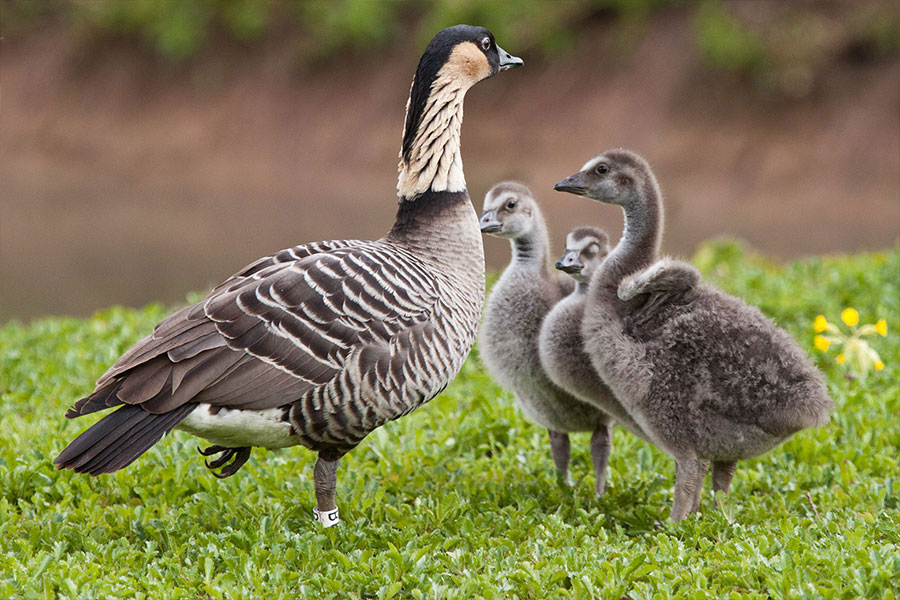 Hawaiian Goose with goslings
Hide and seek
The first challenge for conservationists is to find their endangered species. Some, such as the ivory-billed woodpecker of the south-eastern US or pink-headed duck of south-east Asia, have been missing for so long that, though officially classified as Critically Endangered, most experts believe them to be extinct. But scientists continue to invent ways of finding others. In New Zealand, for example, trained tracker dogs sniffed out the breeding grounds of the kakapo, a flightless parrot once thought extinct. In India, camera traps helped detect the equally rare Jerdon’s courser.
Today, scientists even use chemical evidence in CSI-style forensic searches. For instance, chemical signatures from museum specimens of the slender-billed curlew, a species that hasn't been seen since 2001, are now helping identify possible breeding sites in central Russia. It’s now possible to find elusive aquatic species by detecting traces of their DNA in water or sediment samples, a technique used to find rare tadpole shrimps at WWT Caerlaverock.
And then there’s just sheer luck. Take the Madagascar pochard, this species was thought extinct for decades. Then a small population was rediscovered by chance in 2006, on a single lake, during an expedition in search of another species entirely.
Once we assessed this population, however, we discovered that ecological problems with the lake meant that few ducklings were surviving. Clearly, the birds urgently needed a new home. So, with support by the HSBC Anniversary fund, and the help of our partners, we launched an emergency conservation breeding programme, in which individuals were paired up in a nearby purpose-built aviary, where their chicks achieved higher fledging rates.
Today this captive population has risen high enough for a reintroduction. Meanwhile, a suitable new lake has been found and, back at Slimbridge, floating reintroduction aviaries have been trialled.
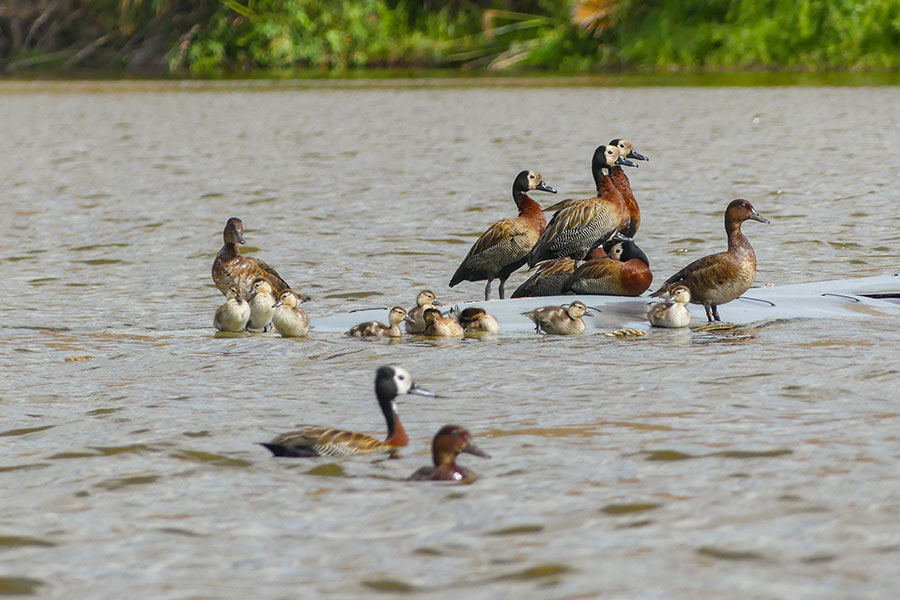 Some Madagascar pochard ducklings swimming on Lake Sofia in Madagascar.
Closer to home
WWT doesn’t focus only on global rarities. We’re equally concerned with those on the brink in our own backyard. After all, our roots are here in the UK, so restoring the birdlife that once flourished here is a top priority.
Take the common crane. By 1600, this charismatic species was extinct in the UK. The Great Crane Project, in which we joined forces with Pensthorpe Conservation Trust, the RSPB and other partners, restored a breeding population to the Somerset Levels and Moors, where it once thrived. Eggs WWT collected from wild cranes in Germany were hatched and reared in a centre at Slimbridge.
In the wild this species maintains close family bonds, so to help these youngsters, a team of special human crane ‘parents’ supervised their upbringing. Dressed in crane costumes, they fed them and took them on walks until they were mature enough to look after themselves. Such techniques are a vital part of conservation breeding, helping to prepare young birds for the challenges ahead.
With the spoonies, for example, the aviary is opened, allowing the fledglings to leave in their own time, and live mosquitoes are attracted to encourage them to forage. With the Madagascar pochards, the youngsters will first be transferred from aviaries to floating cages, with supplementary food provided while they adjust. After 10 days the doors will be opened, leaving them free to explore and find new food outside.
Back in the UK, the cranes are already proving the rewards of this careful approach. A total of 94 youngsters, hatched at Slimbridge, have been released since 2010. This species takes four years to reach breeding maturity, and already pairs are forming and starting to breed.
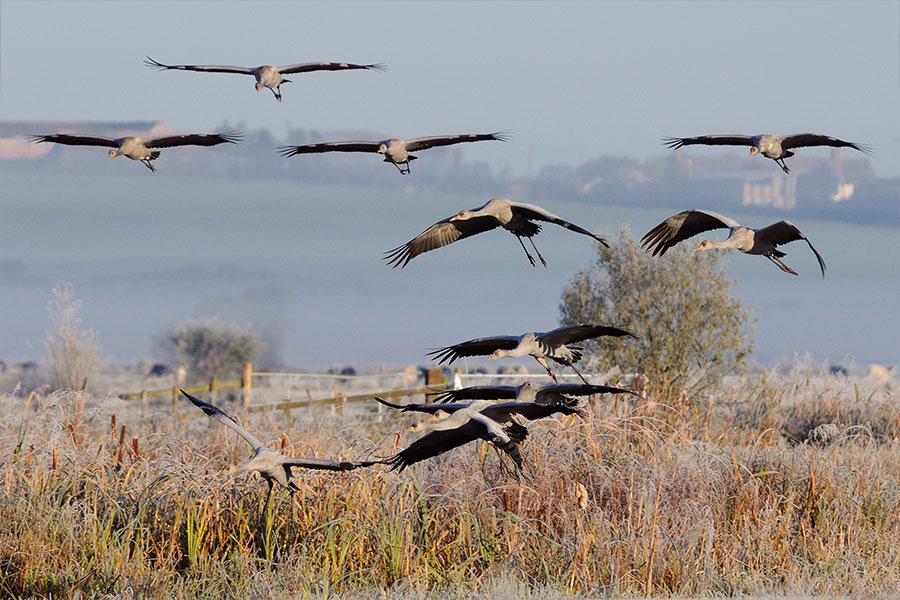 A flock of Common Cranes landing at the Somerset Levels
Looking to the future
Whenever scientists intervene with an endangered bird, they learn lessons for future projects. Our work with spoon-billed sandpiper has helped us embark on the UK’s first headstarting programme for a wader species. Namely the black-tailed godwit, which has a UK breeding population of no more than 60 pairs. Working with the RSPB, and supported by HSBC Anniversary funding, we’re using captive-raised godwits to boost productivity in the wild and help rebuild the population quicker than nature could manage alone.
Meanwhile, technology continues to breed innovation. For example, scientists can now follow the underwater foraging of common scoters, one of the UK’s rarest breeding ducks, using tiny hydro-acoustic tags, developed from those used by biologists studying wild salmon. This is teaching us about the habitats preferred by the scoters on their Scottish breeding lochs.
Geoff believes close-order management has an increasingly vital part to play both in protecting critically endangered birds worldwide, and in restoring to our own country the species that once flourished here. ‘We need to make it more of a mainstream thing,’ he says, ‘not just what you do when you’ve run out of other options.’
You could say that close-order management is interfering with nature, but this expertise allows us to start making reparations. And while such small, little-known birds as the spoon-billed sandpiper may seem insignificant in the grander scheme of conservation, every species evolved as a vital part of our planet’s ecological jigsaw. For centuries we’ve been dismantling that jigsaw, with dire results. Now we have the expertise to start putting some pieces back. ‘Why be passive?’ argues Geoff. ‘Why wouldn’t we restore species for future generations?’
One thing’s certain, there are people out there today, including our dedicated teams and our global conservation partners, who refuse to accept extinction as an option. Inspired by their skill, passion and lateral thinking, we will never say never.
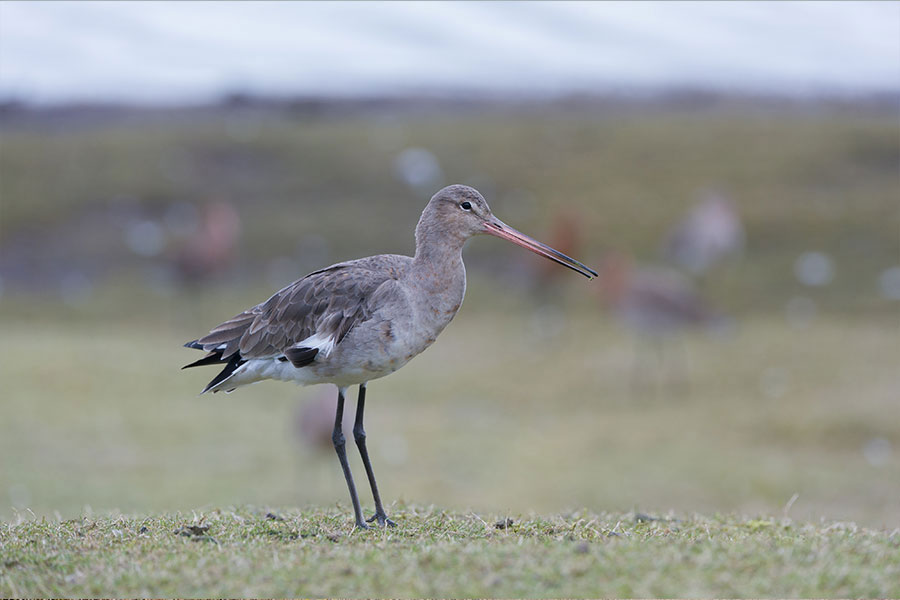 A black-tailed godwit.
Four famous species saved!
WWT’s close-order management is inspired by global efforts to rescue rare birds from extinction.
Kakapo
A large, flightless parrot almost wiped out by introduced predators in its native New Zealand. Remaining birds were removed during the 1980s to three predator-free offshore islands: Codfish, Anchor and Little Barrier. Today, many closely monitored individuals survive. Ecological restoration is preparing more islands to receive this slowly expanding population.
Mauritius kestrel
A small falcon restricted to Mauritius, where, by 1974, DDT and alien predators had reduced the population to just four. In 1979, Welsh biologist Carl Jones removed eggs from sitting females and reared them in incubators at a new offshore wildlife sanctuary. The population grew, and a self-sustaining population was re-established on the mainland.
New Zealand black robin
Endemic to New Zealand’s Chatham Islands. By 1980, only five survived on Little Mangere Island, with just one fertile female: Old Blue. A project led by conservationist Don Merton moved them to predator-free Mangere Island. Old Blue’s annual output was increased by placing the eggs from her first clutch in the nest of the closely related tomtit, a technique known as cross-fostering. The population increased and became self supporting.
Asian crested ibis
A once widespread waterbird thought to have become extinct until a population of seven was discovered in China in 1981. Extensive captive breeding has since re-established the species in Shaanxi Province, central China. In 2012, the first wild chick was born in Japan since its extinction there.
