
You might never have thought about this, but there are a lot of frustrated fish in Britain’s rivers. “You can sometimes see them swimming forlornly against barriers, trying to make their way upstream or downstream,” says WWT’s Wetland Science Manager, Dr Hannah Robson.
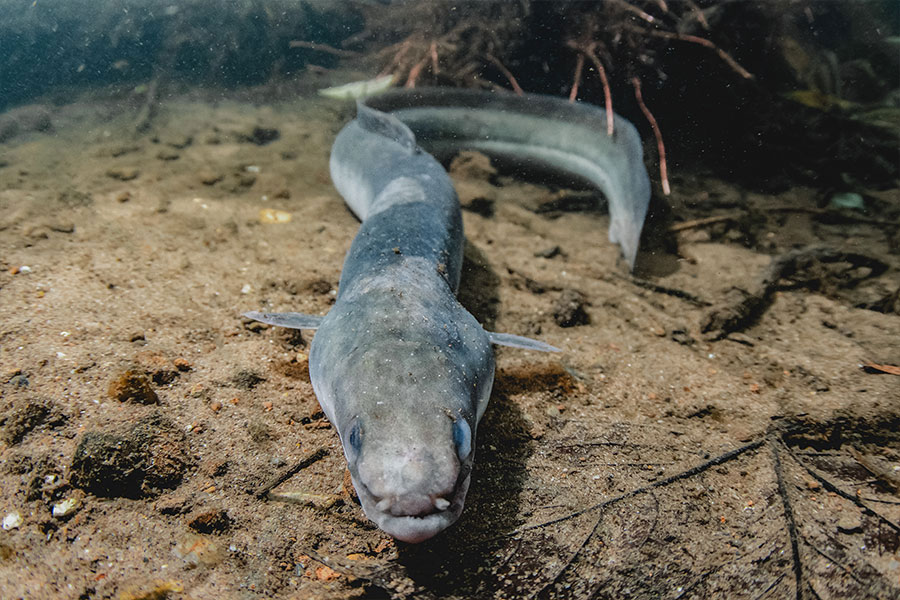
Britain’s fish, especially those that migrate, such as eels and salmon, are often thwarted by human-made constructions. Our riverine arteries were once free-running, but today they are disconnected and fragmented. “There are all kinds of obstacles a migrating or dispersing fish might come across,” says Hannah.
“Take mills, for example. Back in the day, engineers diverted rivers, created weirs and blocked up channels to maximise water flow through mill wheels. They weren’t thinking about the effect on wildlife, but in some places the damaging impact on a particular species of fish will have continued for years, even after the mill was no longer in use. The same can apply to locks and sluices.”
Removing the barriers
To help Britain’s fish, and promote habitat enhancement across the countryside, WWT has been working on ways to open up channels for free movement. In the Severn Vale, we’ve been working in partnership with the Environment Agency, Severn Rivers Trust, the Farming and Wildlife Advisory Group and the Stroud Valleys Project to address barriers in one of Britain’s most important river catchments.
“Salmon are famous for their migration upriver to breed,” says Hannah. “If there is a significant barrier, they can’t reach their spawning grounds and have to make do with conditions further downstream, which may be much less advantageous.”
Even more modest dispersers, such as brook lamprey, which move up and down along river corridors, can be badly affected by barriers. And, of course, every species of fish will benefit from the restoration of high-quality, well-connected habitat.
Removing barriers to fish movement is simple in theory but labour intensive in practice. “Not only is it important to locate new barriers that have not been mapped before, we also need to identify which obstacles within a catchment pose the biggest problem. Then we can work out which ones to deal with first. This depends on knowing not just where the barriers are located, but also what condition they’re in and what mitigation options are possible,” says Hannah.
Even when you’ve found and assessed a barrier, you have to decide what, if anything, you can do to mitigate it. “We’ve been working at three sites in the Severn Vale and each one needs a different solution to maximise the benefits for wildlife,” says Hannah. “Each site has its own topography, ecology and history – we’re learning all the time we work with experts to design and implement the most appropriate solutions.”
Three mills along the River Frome, in Gloucestershire, offer good examples of the variety of solutions. “At Fromebridge Mill we’ve put in a multi-species fish pass,” says Hannah. “At Arundel Mill in Stroud we simply installed an eel bristle pass. And at Bonds Mill we’ve restored a historic river channel, or ‘palaeochannel’, to reconnect the river above and below a structure. The work at Fromebridge and Bonds Mills has opened up 6km of river to fish traffic.”
There’s still a lot to do, but so far the results are encouraging. This exciting work cannot help but improve the habitats – not just for fish but for many other freshwater animals and plants. It’s clear that connectivity is the future.
How we do it
Locate the barriers
Barriers take various forms, but many date from old industrial workings, such as this stone-block weir. Existing data on barrier location is a little out of date, and there’s no substitute for walking surveys that physically track along the river looking for anything that might prevent fish swimming upstream or downstream.
Assess the barriers’ effects
The easiest way to determine the effects of a barrier is to examine the structure itself. This can be done using tools such as the River Obstacles app, which was designed to be used by citizen scientists as well as professionals. It can also be useful to combine barrier data with insights from fish surveys to see which species are present and in what numbers.
Build fish passages
If a barrier is having an impact, the next step is to determine which fish species need help and what they need. The solution varies according to the location. Sometimes a whole new structure, such as a fish pass, may need to be built, but at other times a historic channel can simply be restored.
Monitor the new passages
Once a new fish pass has been installed, we monitor the area to ensure it’s having the desired positive effect on the fish. We do this in a variety of ways; with cameras, fish surveys and by testing samples of water for environmental DNA (eDNA). eDNA helps us detect specific fish species and fish community diversity.
