
Header image: A group of dalmatian pelicans at WWT Arundel
There are wet places in the lowlands where you can sense Britain almost the way it was. It might help if you close your eyes to block a view of a building or a sky scored with contrails, but you can inhale the tangy, fuggy scents of water and earthy, organic ooze. In some places you might even catch the splash of a beaver tail slap or the bugling of cranes. But other sensations familiar to the Anglo-Saxons of the Middle Ages will be missing, such as the swift shadow of a passing pelican, the rushing wingbeats of a cloud of black terns, or the swirl of water teeming with eels.
Wild woods or wetlands?
There’s a persistent popular image of postglacial Britain as wildwood. While there were certainly once more trees than now, these did not provide continuous cover. In fact, much of the ancient landscape was an ever-changing hotchpotch, governed not by forest, but by water. ‘It’s hard to imagine now,’ says Benedict Macdonald, conservationist and author of the acclaimed Rebirding, ‘but 20% of Britain was once under the dominion of water.’ Well into medieval times, if you were to travel from London to York, from Bristol to Southampton, or from Birmingham to Lancaster, you would invariably find the journey difficult and wet.'
Benedict isn’t talking about just reedbeds and marshes. In fact, the picture he paints is one of almost infinite variety, a connected network of ‘freestyling’ lowland wetlands including beds of reeds and sedges, beaver coppice and herb meadows, fens and open water and vast tracts of boggy riverside woodland. Watercourses twisted and flexed – swelling, spilling, spreading, splitting, taking short cuts – often bearing little resemblance to modern conceptions of what a river might be.
This complex, dynamic mosaic was home to species now globally extinct, such as the aurochs (the ancestor of domestic cattle), and many that now seem exotic, such as black stork, Dalmatian pelican and elk. Further species now considered rarities, such as eels, corncrakes, ruff and black terns, would have thrived in numbers almost unimaginable now.
‘These were the true wildernesses of the past,’ says WWT’s Head of Conservation Evidence, Geoff Hilton, ‘but that doesn’t mean they were hostile to people. Think of the great rebel heroes of Anglo-Saxon folklore, such as Robin Hood, Alfred the Great, Hereward the Wake. One of them hid in a forest, but the others took refuge in wetlands with Alfred in the Somerset Levels, and Hereward in the Fens. These were places where it was easy to hide, but also where it was also easy to live, because food was so abundant. Eels were so readily available they were used as currency.’
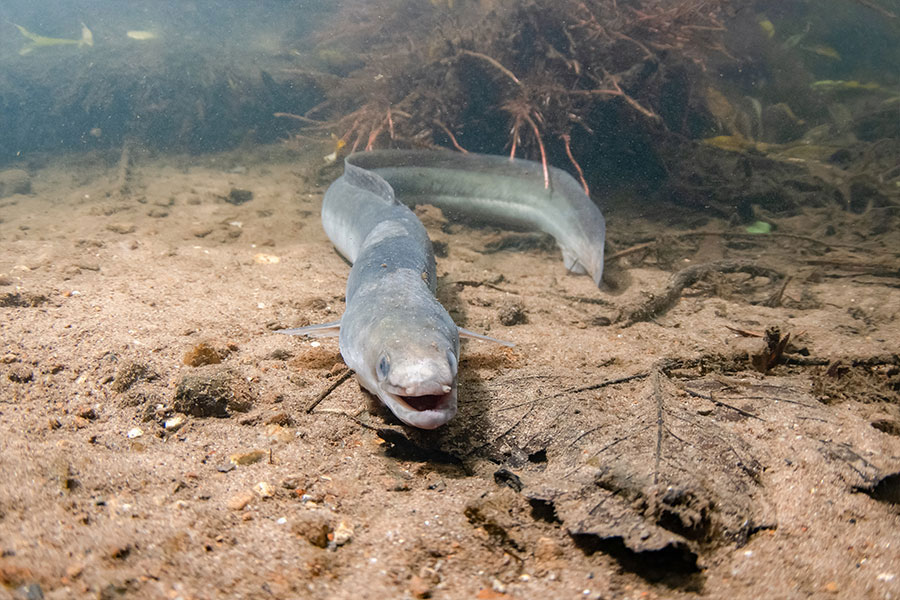 A connected network of 'freestyling' lowland wetlands would have been teeming with eels
Landscape architects
If the engine of these astounding ecosystems was water, their stewards were animals: grazers, carnivores and disruptors. Large herbivores such as aurochs and elk (and back further still, elephant and hippopotamus) clipped and mowed; top predators such as wolves and eagles kept their smaller competitors and prey in check, while the interventions of beavers opened the tree canopy, continually renewing opportunities for other species and driving a cycle of succession from wet woodland to pool, meadow, scrub and back to woodland.
Many of these great wetlands, such as the Cheshire mosslands, have been all but lost, while the fragmentary remains of others in Cambridgeshire Fens, the Somerset Levels and the Humberhead Levels bordering Yorkshire, Lincolnshire and Nottinghamshire give us an inkling of what was and what could be again.
Wetland creation and expansion projects such as the Great Fen, Wallasea Island and the Avalon and WWT Steart Marshes mean we are seeing more bitterns and the return of night herons and spoonbills, little and great white egrets, and common cranes.
In 2020, introduced white storks bred on the rewilded Knepp Estate in Sussex and young white-tailed eagles released on the Isle of Wight were tracked the length and breadth of England. Beavers are being introduced in projects around Britain, though in most places they remain fenced in.
Benedict speaks for a growing number of ardent rewilders from across the political, social and economic spectrum in calling for the restoration of nature and natural processes on a huge scale. And given that his ideas involve vast areas of land, it’s perhaps surprising that an increasing number of farmers and land managers are interested.
Human communities are crucial to the vision, and Benedict is convinced that rewilding is highly compatible with extensive agriculture. ‘If you visit the Biebrza Marshes of Poland, you see a wetland mosaic bursting with both wildlife and farmers. It works ecologically and economically. Meanwhile, in the Somerset Levels, farming plays a small part in the local economy, supporting few jobs, despite taking up a huge proportion of land area.
‘That land could be utilised and harvested in many more ways – forestry, angling (one of the most popular and profitable leisure activities in the country) and enormously diverse tourism, from boat hire to guiding and hospitality and even,’ he says cautiously, ‘sustainable hunting.’
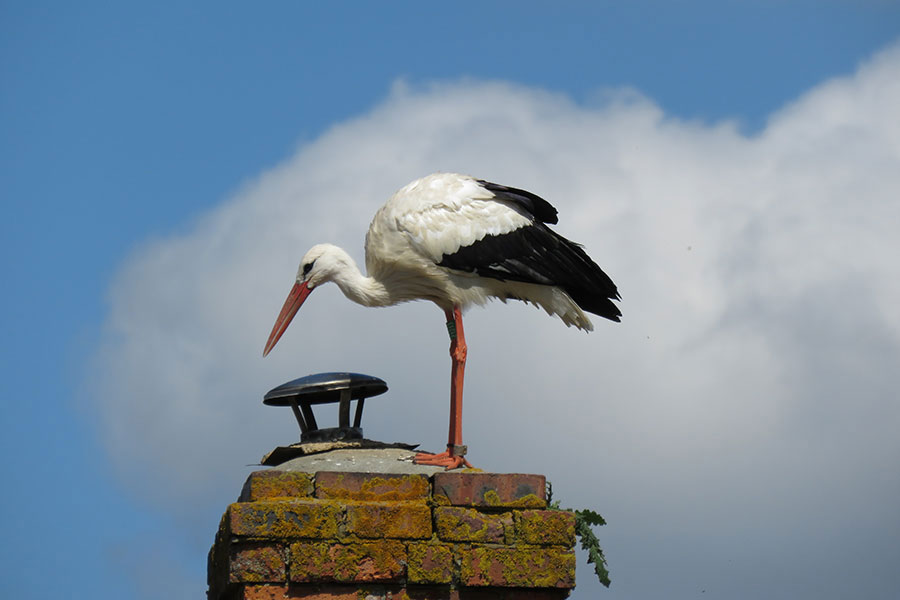 A white stork on the cottage chimney at WWT Slimbridge
Ancient breeds
Given this potential to both boost the local economy and relieve the national purse of the costs of inevitable flooding, Benedict suggests that – rather than supporting farmers to produce livestock intensively as happens now – the best thing might be to pay them to keep fewer cattle of old breeds, which roam over much wider areas than at present but accrue a higher price per head. He recommends we also work with beavers to restore ecosystems that will protect landscapes and homes, lock away carbon and replenish groundwater that can be used to supply more conventional farming in adjacent areas.
Species restoration is part of rewilding. Some species return of their own accord, but this is uncertain and can require long timescales. In nature, complexity breeds complexity, species create niches for species, building resilience and improving balance in an ecosystem. The future Benedict sketches out begins with beavers and ends with pelicans. ‘We need water on the land, not only as a nice commodity for cranes or bitterns, but also for farmers and people. And no animal keeps water on the land better than the beaver.’
Enormous Dalmatian pelicans are seen as a flagship, rather than a keystone. ‘As avian megafauna, their charisma could draw in community stakeholder communities, visitors and certainly children,’ says Ben. ‘But they are also top predators and indicators of fish-rich, massive wetlands. You can have a bittern breeding in a large sewage works these days, but you can’t have pelicans without scale.’
How big are we talking, I wonder? ‘In the Somerset Levels, it would have to be many times, perhaps 10 times, the area we currently have. On a wetland of that scale, there would already be night herons, pygmy cormorants, storks and cranes, white-tailed eagles and corncrakes, as well as waders including ruff, lapwings, curlews and more.’
Using the distant past to inform the near future is eye-opening, thinks Geoff, especially when it comes to the pervasive phenomenon of shifting baselines. ‘Take willow tits – a bird of wet woodland that has declined to near extinction in recent decades. As ecologists, we’ve been looking back to the 1970s to understand why we see fewer of them now, when in fact we should’ve been thinking about how things were 5,000 years ago. We’ve been terribly naive, imagining the scraps of habitat where willow tits survived in living memory were somehow ideal, when in fact they were just what was available at a time the species was less scarce than now.’
Three great crises facing humanity – climate change, biodiversity loss and wellbeing are inextricably linked, and rewilding with species restoration is ambitiously billed as a solution to all three. Is it the answer? There is a definite ring of excitement in Geoff’s voice. ‘I don’t want to belittle recent achievements. We have more good-quality wetland now than we’ve had for 100 years. But the vision being offered is different in scale, and in it we are braver, bolder and quicker to act.
‘There’s been a reluctance in British conservation to try anything without a 10-year feasibility study and a guarantee of success. And frankly we don’t have time for that. It feels to me that now is the time to think big, in the knowledge that mistakes are something we will learn from. Given our expertise in wetland creation and management and species restoration, there seems to be a role in British rewilding that is tailor-made for WWT.’
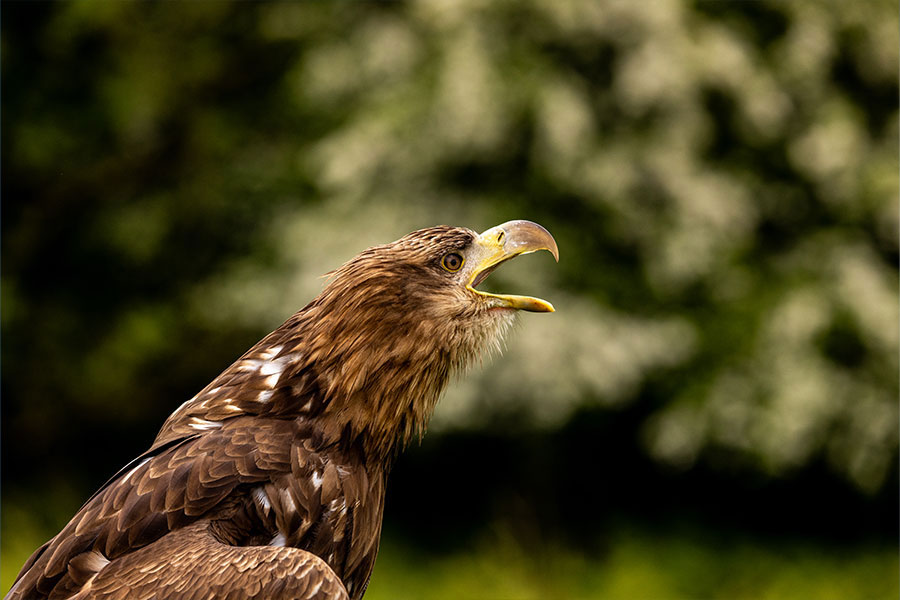 White-tailed eagles are a missing part of England’s native biodiversity.
Further rewilding reading
Feral - George Monbiot (2013)
Wilding - Isabella Tree (2018)
Rebirding - Benedict Macdonald (2019)
Bringing Back The Beaver - Derek Gow (2020)
The Missing Lynx - Ross Barnett (2019)
English Pastoral - James Rebanks (2020)
How beavers shape the land
On medium-sized rivers, beavers build breeding lodges on the banks, accessed via burrows with underwater entrances. Only where the water is insufficiently deep for such an arrangement will they build dams. These are perfectly imperfect structures – impermeable enough to hold back pulses of water but leaky enough to release it over time.
But it’s the longer-term effects of beaver activity that make this a keystone species. To ensure their food supply, these herbivorous rodents exercise a sort of cut-and-come-again strategy, felling trees to encourage bursts of succulent new growth. When humans do this, we call it coppicing, but beavers have been creating coppices far longer and are undoubtedly a major reason trees cope so well with the treatment.
A coppiced woodland is lighter and airier than one with a closed canopy – and light brings floral diversity and insects. The insects bring birds and bats. Beaver pools are perfect for amphibians to breed in and create opportunities for fish, herons and grass snakes.
Beavers do not eat fish, and their dams are rarely an impediment to native species, which can usually leap or swim over them when the water levels rise naturally. Over time, beaver pools may silt up and succeed into meadows and new woodland as new dams and pools appear elsewhere.
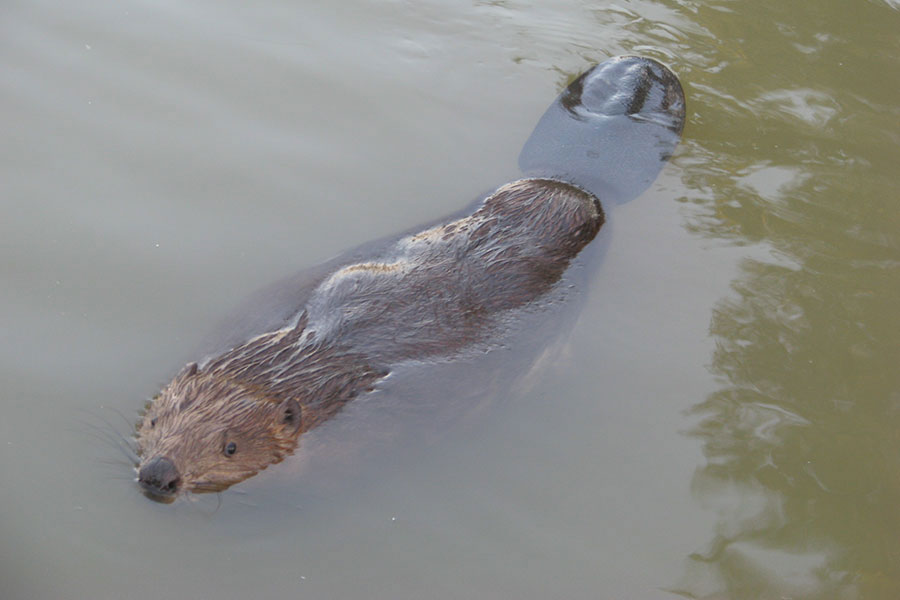 Beavers are being introduced in projects around Britain
