
Almost every day, terror comes to the wildest parts of our centres. And often you can witness it.
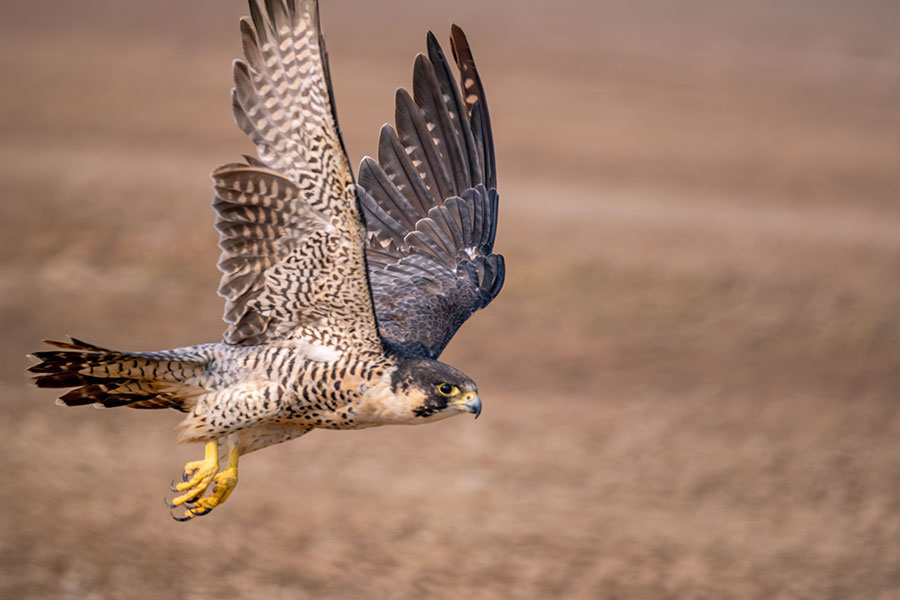
The rich feeding grounds around our pools and estuaries attract large numbers of birds, such as wildfowl, waders and gulls, particularly in winter. Look out from one of our hides and you'll probably see masses of birds, all calmly going about their business. To a predatory peregrine falcon, they are all potential food. To survive, it must spend its day hunting them. An attack is always coming.
Panic in the skies
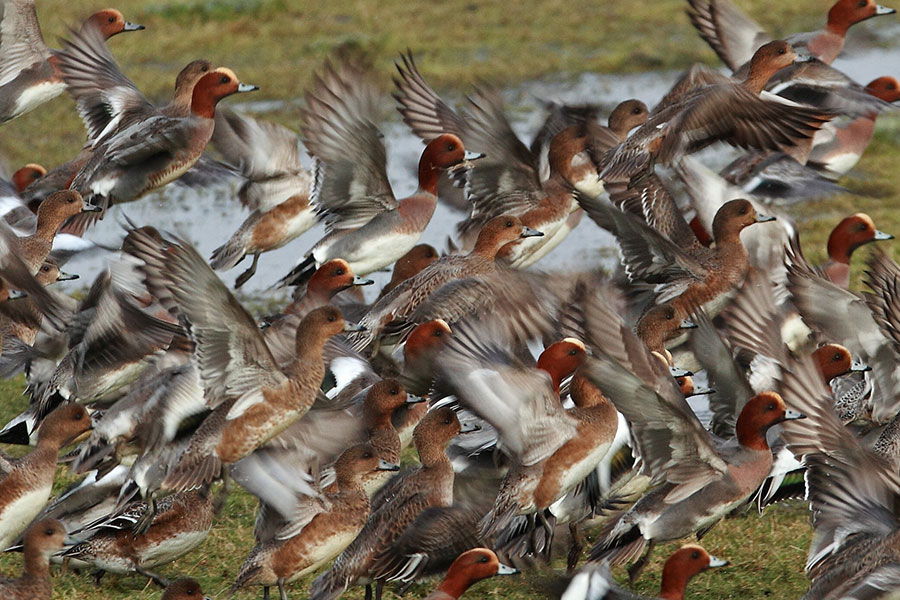
"You can be looking out across the reserve and everything is peaceful, birds are feeding on the mud or swimming in the water," says Martin McGill, Senior Reserve Warden at Slimbridge. "Then suddenly, without warning, one of them spots danger and pandemonium breaks out. Flocks of birds are flying and swirling in all directions in what looks like complete panic. It's amazing."
A peregrine attack is messy, unedited real life. Birds are flying for their lives, and there is no script. There is, however, some strategy involved. Most waders take off and form small, tight flocks, which swirl rapidly this way and that, in manoeuvres that are intended to confuse a predator.
Staying alive
Clever ways birds protect themselves from predator attacks.
1 Anticipation
For some reason, if lapwings are present, they are invariably the first birds to fly up when faced with a predator. Flocks often take off - even if it's a false alarm.
2 Calling
Every bird in a flock responds when the first individual makes an alarm call - and many follow suit. An attack is a noisy event.
3 Vigilance
Even when feeding and sleeping, birds never let their guard down. They constantly look up for danger, whatever they are doing. Ducks that appear to be asleep open their eyes regularly - watch them!
Flocking together
Geese will make a mass take-off, with much loud calling. Flocks of ducks will also take off, but some might head for open water and, if the hunter is close, dive under as a last resort. Other birds will bolt for cover, if there is any. Nothing is unaffected. A pass by a peregrine induces a reaction in everyone – the scene may be left empty of any birds at all (though swans are usually safe).
Invariably, though, when in danger, birds flock together. At a basic level, an individual on its own has a 100% chance of being chased, but in a flock of 100 the risk is reduced to 1% (this is called the 'dilution effect'). In a flock, more pairs of eyes watch a predator's movements. Flocks flying in the air show the predator they know it is around. The 'panic' isn't mindless.
As for the peregrine itself, its aim is to come upon birds by speed and stealth. If it loses either, its attack will probably fail.
You might see a small shape in the distance or, if you're very lucky, you might see the sickle-winged peregrine in a life-or-death chase with another bird. The irony is, though, that the most spectacular part of a predator attack is usually the reaction of the hunted. Amid the melee, you might not spot the main player in the drama at all!
Where to see a peregrine falcon
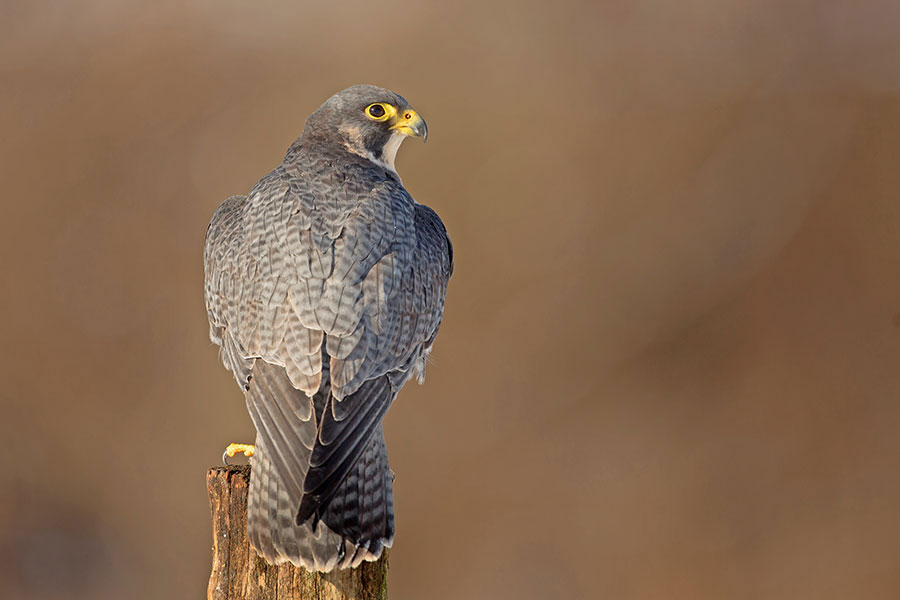
Peregrines are widespread in the UK through the western part of England, and reach their highest densities in upland areas of Wales, southern Scotland and north-west England. In winter, look for them on east-coast marshes where there are large gatherings of birds.
4 other raptors to spot at WWT sites
Fancy your bird if prey fix? Visit one of our wetlands for your chance to spot these incredible birds.
Merlin
This diminutive hunter surprises small birds in open country, typically launching a high-speed attack to catch them in
mid-air. It often flies low, chasing prey upwards until it tires.
Kestrel
The sight of a kestrel hovering rarely causes alarm among other birds, as it is mainly a hunter of small
mammals.
Sparrowhawk
A specialist bird-hunter, the sight of a sparrowhawk induces panic. Only geese and larger birds are unlikely
to scatter. Capable of flying in short bursts at up to 50kmph, it's built for manoeuvrability in pursuit.
Buzzard
With its large size and broad wings, the buzzard doesn't catch many birds. So when the flocks see one, their reaction tends to be muted.
Time for your next nature fix
It's always a good time to visit our wetlands. Not a member? Book online and save time on arrival.
Find your nearest WWT wetland site