
Header image: Steart Marshes is one of the UK's largest new wetland reserves
Water is a pussycat. Or so we like to think. A bit wild, sure, but at the same time homely. Basically, nice to have around. Sometimes it’s playful and kittenish, in tinkling brooks and tumbling streams; sometimes, in lakes and broad rivers, it’s as majestic as the Egyptian cat-god in a pharaoh’s tomb. But either way, essentially safe.
Wetlands are jumping with the life that comes from water: we see them as benign, generous-hearted places and we’re right to do so. But the pussycat is not the whole story. A trip to Steart Marshes makes that very clear. Here, the water is sometimes a pride of lions on the rampage, sometimes a tiger lying in wait and sometimes a cheetah moving at unstoppable speed… and then, when you least expect it, it’s just purring on the hearthrug.
Water in its fierce moods can change a place forever and do so overnight – and change it all over again the next day or the next year or the next decade. Over 10 years ago, the place I am walking on was a field of oilseed rape. A few years ago it was a saline lagoon. Now, it’s a saltmarsh.
The marshes lie on the Steart Peninsula: a not-quite island that sticks out into the Severn Estuary with the River Parrett on one side: a great watery landscape rich in sky and, during my visit, echoing with skylarks. Though perhaps it’s more accurate to call it a great landy waterscape. It’s not actually water, but not really land either. In many places (and times) it can change in an instant.
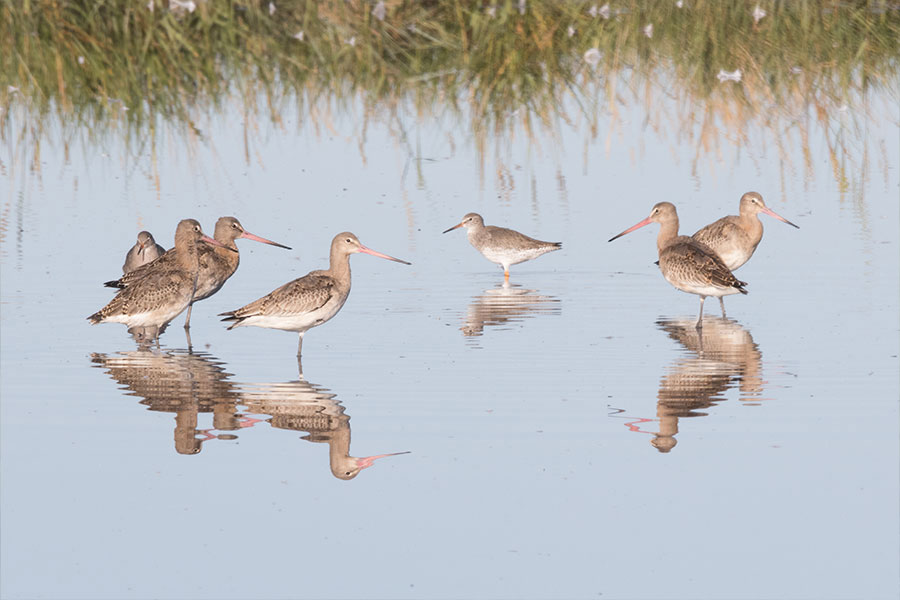 Steart's location between the mouth of the River Parrett and the Bristol Channel is the perfect position for migrating birds, such as these black-tailed godwits
Managing change
The place is now owned by the Environment Agency and managed by WWT. The local landowners were happy to sell because they were afraid: the tigerish rising waters of the Severn Estuary are becoming more ferocious every day with the driving power of the climate crisis behind them.
The wall built to keep out the sea is no longer big enough or strong enough to do the job. It breached for the first time in 1981. Saltwater was soaking into the once-sweet fields and the power of water was changing everything. So WWT took the place on. After all, wet land is what they’re good at.
How do you solve a problem caused by too much water? Add more water, of course. When you’re dealing with a volatile landscape (or waterscape) like Steart, you soon realise that normal, intuitive understanding doesn’t work.
Once more unto the breach, dear friends, once more! I was last here seven years ago, and now Alys and I are back at the spot, near where the Parrett meets the Severn Estuary, where the seawall was opened permanently – and deliberately. At a stroke, WWT was no longer fighting the implacable forces of water-driven change but – quite literally – going with the flow.
Water works
That was in September 2014. People lined the banks to see the first tidal inundation. They were thrilled by the change – and not a little fearful. They were worried that the inrushing tides would cause flooding further inland: that more water was the last thing anyone needed.
But it hasn’t happened. And that’s not just a relief for the people of Steart Peninsula, it’s a fascinating demonstration of the way water operates in the time of climate emergency – and how best to deal with it. Not by fighting, but with a carefully managed yielding.
The reserve has expanded massively since my last visit: Bridgwater Bay has been added on and that brings 2,600 hectares to the original 488. Most of the new stuff is mudflat, where all the management is done by the water itself: the twice daily tides. The rich sediment, filled with invertebrate life, is a vast larder for ducks and waders, and on good days you can even see dolphins and porpoises in the river.
And there is the new seawall, a kilometre back from the old one and a good metre and half taller, a lofty bank. “Basically, a five-kilometre-long hay meadow,” Alys says. The skylarks sing on to make sure I understand. The area between the two walls is rich with saltmarsh: a community of specialist plants that supports a busy community of invertebrates.
“This place doesn’t freeze,” Alys says. “So, the invertebrates are active all year round, and that means bats can feed on them all year. We get 11 different species here, including uncommon species such as lesser and greater horseshoes.”
 Owners are welcome to bring their dogs to Steart Marshes. It's a great place for you to enjoy together.
Changing tides
Saltmarsh is a mysterious habitat, not much studied. “It’s harder to look aft er than the rest of the reserve because there’s much less data to inform decision-making,” says Alys. Cattle roam the place, now managed in a way that works with wildlife. “This is still a working wetland landscape,” Alys explains. The cows feed on samphire and sea aster, and local farmers sell saltmarsh beef as a premium product. Water floods routinely into this land, but the land soaks it up like a sponge, at the same time absorbing the constant shock of the wave action. It’s also a great landscape for carbon storage.
We move inland, to areas of saline lagoons, and something that feels more familiar: a place that is more like a well-managed nature reserve, with avocets and the hectic calls of never-calm little ringed plovers. Still further inland the place becomes a freshwater habitat, fed by rain, and there are reedbeds jumping with the song of reed warblers. The place is like a textbook of the different ways water interacts with land.
Climate breakdown is not something to do with the future. It’s been happening for 200 years and it’s getting faster. And hotter. As a result, the sea is expanding and taking up more room; that’s why sea levels are rising. Hotter air holds more water – 7% for every degree Celsius – so rainfall is getting heavier. The future of our island is about learning to live with more and more water.
Steart is teaching that difficult lesson. As I walk the paths, I can feel my understanding of water shifting. The endlessness of the sky, the endlessness of the flat landscape and its ever-shifting relationship with the water: rich with the feeling of life responding to constant changes. It’s an edgy place, full of uncertainties. It has changed very much since my last visit; it will have changed again when I make my next.
 The marshes are a powerful natural tool in protecting against the effects of climate change.
The wetland way
We humans can fight water for as long and as hard as we like, but the water will have its own way in the end. Here at Steart, the waterscape is being cajoled and persuaded rather than confronted, in the knowledge that in the end it will do what it wants to do. A soft landscape, created by a soft approach to the power of water. A spoonbill, a roe deer, a meadow brown butterfly, a broad-bodied chaser dragonfly; and again and again, a little egret, the signature bird of the place.
This species was a wild exoticism half a century back, now it’s a daily delight. We live in changing times, and this lovely white bird, flying across the waterscape trailing its yellow feet, tells us that nothing stays the same and this landscape will change and then change again.
I wonder what it will be like next time I visit…
Simon Barnes is the author of a multitude of wildlife books and articles. He was the chief sports writer for The Times until 2014, has sat on the boards of wide-ranging wildlife charities and was awarded the Rothschild Medal for services to conservation in 2014.
