
Header image: Black-headed gulls are sociable, quarrelsome, noisy birds, usually seen in flocks. In winter, numbers are boosted by birds arriving from Europe
Love them or loathe them, you can’t avoid gulls. From their ear-piercing cries overhead to their penchant for stealing fish and chips at the seaside, gulls barge in on your senses like uninvited guests. You cannot miss them at WWT centres, wherever there is water, they will come. ‘I find gulls fascinating,’ says Ian Hull, a Guide in the Hide at WWT Slimbridge.
‘What I love most about them is that they’re always doing something. One moment they’ll all be loafing around, the next moment an argument will break out and there’s pandemonium. I’d describe them as mischievous birds.’ Whenever somebody enters a hide where Ian is stationed, he isn’t afraid to point out the gulls. ‘Some people think they’re boring, but that’s probably just. because they can be difficult to tell apart. But if you look at them carefully, things fall into place. Take the common gull. It’s clean-cut and neat, and its dark eye gives it a kind, gentle expression. It’s a gull you’d be happy for your daughter to date!’
Once people spend a few moments looking at the gulls, the birds soon excite curiosity. ‘Every so often, you’ll see a large gull grab a stone or stick and fly up a few metres into the air, before dropping it to the ground,’ says Ian. ‘Everyone asks what it’s doing. But I don’t think anyone knows – maybe it’s practising dropping shellfish on a hard surface to break them open. Or it could just be having fun.'
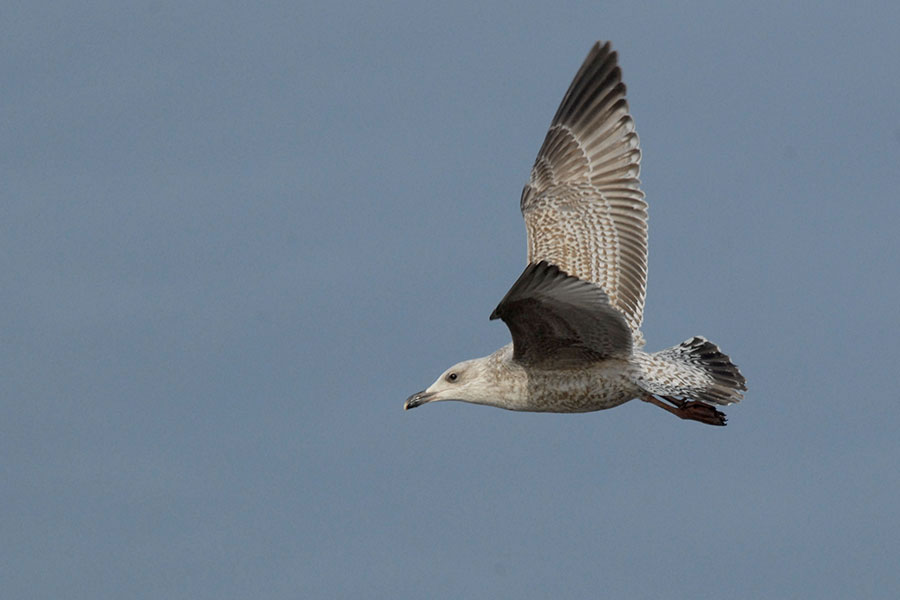 The quintessential ‘seagull’, the herring gull is a large, noisy bird seen on coasts and inland
Evening spectacle
Many WWT centres host gull roosts, or pre-roost gatherings, which is a particular feature of the short winter days. ‘In the late afternoon, as the light fades, gulls gather for a wash and brush-up,’ says Ian. ‘This is a great opportunity to watch many gulls at once, often several species mixed together. ‘Here at Slimbridge we can often see many hundreds of black-headed gulls, with the odd Mediterranean mixed in. Sometimes we spot a bird that’s been ringed – by reading the serial numbers on the leg rings, we know that some of our birds come from Poland.’
It’s clear Ian loves gulls, and he wants other people to enjoy them too. But what was it that fired his own interest? ‘For many years I worked as a mounted policeman in Bristol,’ he says. ‘Every spring, the herring and lesser black-backed gulls would fly down and attack me on my horse,’ he recalls. ‘They were just protecting their nests. But I admired their character – bold and aggressive.’
Six gulls to spot
1. Black-headed gull
The smallest gull and often the most abundant at WWT centres. In winter, it has a spot behind the eye, which the other gulls don’t. Bill is red or bright orange. Wings are sharply pointed and show white isosceles triangle between shoulder and black wing tip. Abundant everywhere.
2. Lesser black-backed gull
Like a herring gull-sized great black-back, but with bright yellow legs. Rarely seen in big numbers, and more of a freshwater species than great black-back. Has dark streaks on head in winter, unlike great black-back.
3. Herring gull
The most common and abundant gull near the sea. Very big, with a permanently angry expression owing to its pale eyes. Adults are silver-grey on the back and in winter have brownish streaking on the head; immature birds are brown, multi-blotched and difficult. Legs are pink.
4. Common gull
Common, but not as common as its name suggests! Despite plumage similarities, much smaller than herring gull; little bigger than black-headed. Yellow legs in spring/summer fade to grey or green in winter. Bill yellow/green.
5. Great black-backed gull
The world’s largest gull. In flight, its huge body and broad, arced wings may recall a heron. Large bill does its job, as it is predatory and a scavenger. Heavy body with truncated rear end. Adults have very black backs and rather broad and obvious white wing tips. Legs are very pale greyish-pink.
6. Mediterranean gull
Looks like a black-headed gull that’s been in a fight, with a bruise on its head. Long, scarlet legs and thick, blood-red bill help distinguish it from slightly smaller black-headed. Not very common, mainly in the south.
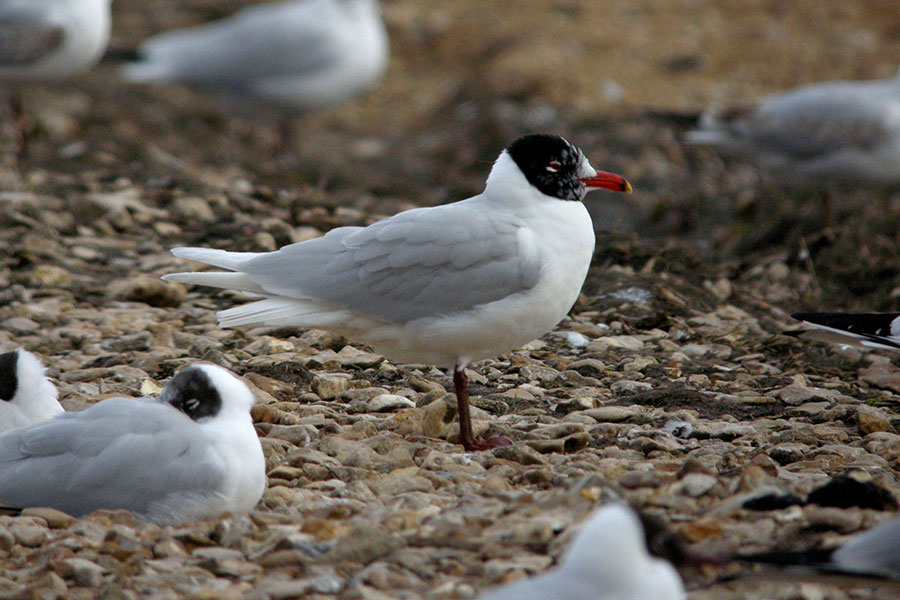 The Mediterranean gull is slightly larger than a black-headed gull, with an all-black head in the breeding season.
