
The chances are, just reading the name ‘WWT Caerlaverock’ has you thinking of wintergreen pastures and spectacular throngs of geese filling the sky with noise and drama. But it’s not geese with which this reserve is literally synonymous: Caer is Scots Gaelic for ‘castle’, and laverock means ‘skylark’. To visit in summer, and creep out onto the saltmarsh towards the vast mudscape of the Solway Firth, is to be drenched in skylark song. It pours down, heard even above the whistle of wind and the ceaseless white noise of a million shifting rushes and reeds.
Perspective here is everything. From a sitting or supine position, the saltmarsh feels lively and complex. Plants lean in, crowd around, whisper. All are species tolerant of occasional inundation with saltwater. Some are familiar, like clover, bird’s-foot trefoil and silverweed; others less so, like parsley-leaved water dropwort, arrowhead and dainty rushes.
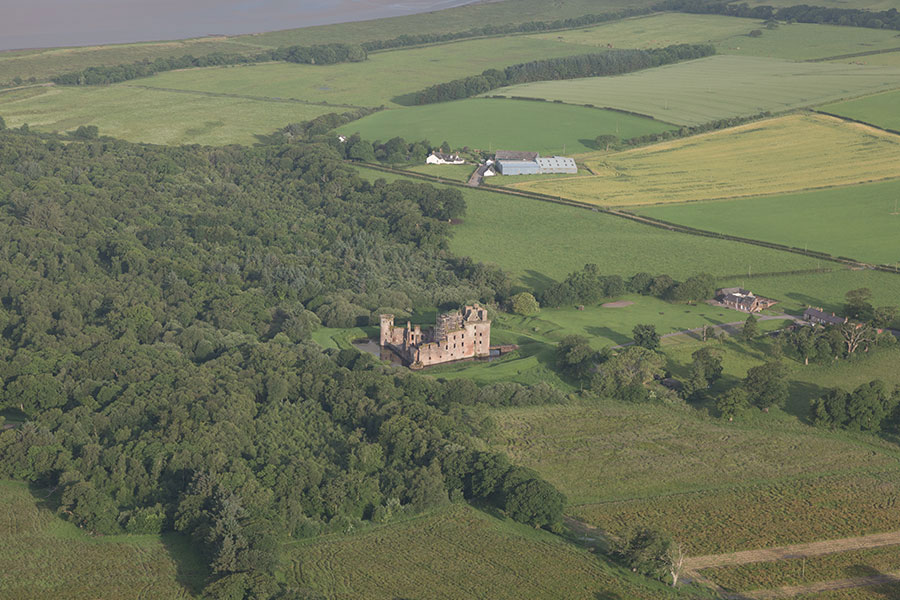 An aerial shot of a castle at Caerlaverock under repair.
But when I stand up, the same place seems suddenly empty and enormous. Swathes of club-rush ripple like the pelt of some huge shaggy beast, and to the south I can see nothing but sky all the way to the Lake District fells. To the west, and much closer, is the distinctive hulk of Criffel, an isolated hill overlooking the Solway Firth. The larks have a different view again. If I could look down from where they sing, this apparently endless marsh would be revealed as just a narrow fringe of green, pocked and permeated by a thousand creeks and pools before the vast expanse of flat mud and the brackish ebb and flow of the estuary.
If I could switch again, and behold the place as Criffel does, with a geological perspective as broad in time as it is in space, the whole landscape would begin to ripple and shift. Tide by tide, the creeks and pools would come and go; year by year, the courses of the Solway and the Lochar Water would flex and lash like writhing snakes; and decade by decade the water would rise and fall.
A great era of research
Caerlaverock was first leased by Sir Peter Scott in 1970, which makes the reserve the same age as me. His original intent was to increase numbers of overwintering geese, which had begun grazing the recently improved cattle pastures. His ambition was realised to spectacular effect. Goose numbers boomed (until hard hit by avian flu in the winter of 2021), allowing a great era of research. Much of what is known about Svalbard barnacle geese dates to ringing and observations conducted here from tiny fibreglass roadmender’s huts repurposed as hides.
These years have seen the world changing faster than at any other time in human history, but these changes are nothing, perhaps, compared to what is coming. A new report, Predicting Future Climate Change, by WWT’s Senior Research Officer, Sietse Los, provides some insight into what the climate emergency might mean for our wetland habitats. At Caerlaverock, the changes are likely to include sea-level rises of half a metre by 2100. By the year 2300, the entire footprint of the original reserve might be tidal.
For all the challenges this will bring, change has always been part of the picture in this shifting waterscape: water rising and falling, species coming and going, tides of human intervention. What all our wetlands need in order to continue holding water, sequestering carbon and providing resilient habitat for multitudes is to be bigger and better connected.
 More than 15,000 barnacle geese overwinter in the Caerlaverock area
Fortunately at Caerlaverock, opportunities abound. Soon after leasing the reserve in 1970, Sir Peter bought three small farms to the north, just across the Lochar Water, to enlarge the area managed for wildlife. For 50 years these were rented to tenant farmers, but all have now been taken back in hand, effectively making the reserve almost 50% bigger.
A guided tour
Reserve Manager David Pickett starts a tour by showing me a skylark-eye view of the site: a satellite image showing the familiar bright-green goose pastures, the scattering of pools, the winding course of the Lochar, the saltmarsh and the tidal mud. He explains that the landscape was once far wetter than it is now. The higher ground to the north was raised bog, and the tidal fringe was saltmarsh. Between the marsh and the bogs was species-rich wet grassland.
In more recent centuries, the bogs were planted with conifer forest, floodbanks and drainage were installed to reclaim some of the saltmarsh for farming, and much of the grassland was ‘improved’ for grazing.
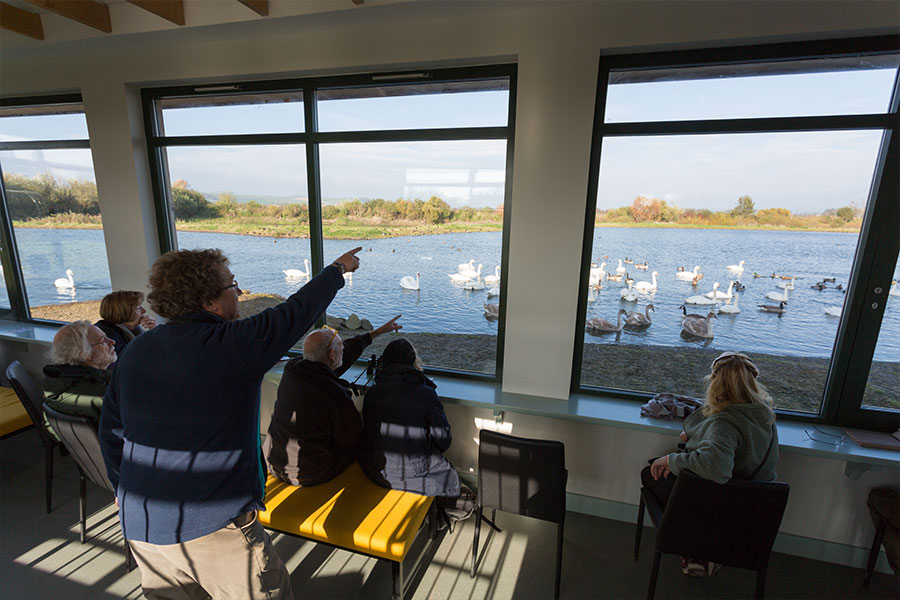 A staff member talking to a group of visitors in the Sir Peter Scott observatory looking over at WWT Caerlaverock
Since coming to Caerlaverock almost two years ago, David has found himself asking the same question about almost every aspect of the job: why are we doing this now? It’s important, he says, because so much changes over time (climate, technology, ecological understanding, budgets, policies, public attitudes). Decisions and practices that made sense years ago might need revising.
“For a long time we’ve been using the agricultural practices that drew the geese here in the first place, ploughing and resowing the pastures every three years and working to maximise the grazing. We’ve been ‘farming’ the land for geese. At the time Caerlaverock was established, barnacle goose numbers on the Solway Firth stood at about 3,700 [following a nadir of c400 in the 1940s]. That figure has now risen to a robust 40,000. These techniques have been highly effective, but not terribly wild.
“We’ve also been rushing water draining from the former bogs and falling as rain through modified channels, pipes or drains to the river and the sea, while at the same time using a pump in dry summers to bring water from the river to top up the Folly Pond. We’ve been tidying up when nature wants to be, dare I say it, a bit scruffy.”
Now, thanks to support for wetland restoration from the Scottish Government’s Nature Restoration Fund, managed by NatureScot, and with the new land brought under direct WWT stewardship, David sees all kinds of opportunities to create a ‘Wilder, Wetter Caerlaverock’ that will be more diverse, dynamic and resilient. These are likely to involve slowing water down, bringing it back to the surface and restoring natural hydrological and ecological functions. The effects of a recent natural breach in the floodbank on Powhillon Farm, which may once have been regarded as disastrous, are now being viewed with keen interest.
 The main centre building at WWT Caerlaverock with a flock of barnacle geese flying infront of it.
The wildflower meadows alongside the Lochar Water, currently a sea of red clover and yellow rattle, give an indication of how the famous goose pastures might have looked pre-intensification. Easing off on pasture management might reduce the appeal of the site for geese, impacting their numbers, but the enlargement of the site should mean no overall loss of provision. And by managing the land for other species, we will boost biodiversity in ways we cannot yet predict – so we will monitor the effects and adapt our plans.
Resilience is a matter of options and contingencies, like the many threads in a web or the creeks in a marsh. Take Caerlaverock’s beleaguered population of natterjack toads. In the 1970s, they thrived in the ‘borrow pits’ created when soil was dug to build screening banks so visitors wouldn’t disturb the geese. There were sometimes so many it was hard not to tread on them, remembers David. Over time, they’ve dwindled and now numbers are lower but stable.
Toads in a hole
The ideal natterjack pool is shallow enough to warm up quickly in spring and dry out in late summer, preventing colonisation by predators such as sticklebacks, which require permanent water. But natural succession and increasingly unpredictable weather mean that optimum pond depth varies year on year.
What’s needed are pools of varying depths and ages to provide more flexible opportunities as conditions fluctuate. Building resilience also means thinking about where the toads might breed and hibernate in future as sea levels rise. So the Nature Restoration Fund is supporting the creation of more suitable habitat for Caerlaverock’s natterjack population.
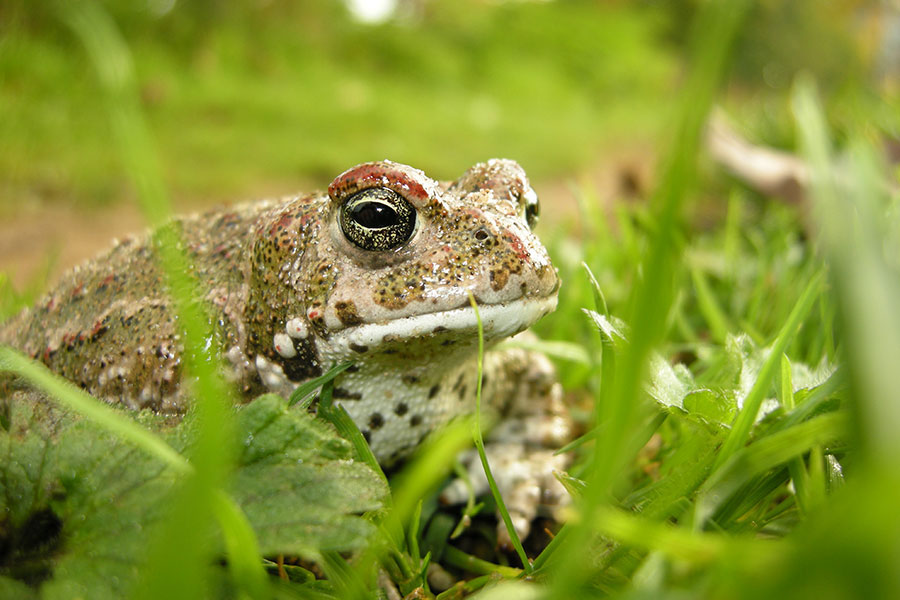 The natterjack toad is rare in the UK and found in only a few locations
What does ‘more connected’ look like in practice? It might mean thinking well beyond reserve boundaries and seeking opportunities for collaboration and consensual change at landscape scale. Again, this is happening at Caerlaverock, where the Forestry Commission is restoring a raised bog on a felled plantation on the northern boundary, and the Caerlaverock Estate is making changes to boost wildlife and improve climate resilience. We’re working with all our neighbours to share knowledge and coordinate management actions to benefit biodiversity across the Caerlaverock landscape.
The power to restore nature
Caerlaverock is also role-modelling a remarkable make-do-and-mend approach to habitat creation. This matters because being better connected is also about people: about outreach, education, inspiration and empowerment. Even small changes can be profound, and I noticed some as soon as I arrived. The space around the visitor centre, previously an expanse of grey stonechip and clipped grass, is looking distinctly shaggy and vibrant.
 A staff member doing a wild bird feed on whooper pond outside of the sir Peter Scott observatory at WWT Caerlaverock
There’s a new area of wildflower meadow and a proliferation of troughs and tubs, brimming with a rainwater channel from the surrounding rooftops and sprouting with wetland vegetation. They include repurposed stone drinking troughs hauled in from the farms, and other types of tank and container – even an upturned hard hat containing a miniature weedy pond. It’s a bit eccentric, comical even, but the message that no meadow or body of water is too small is a powerful one. These are habitats anyone could make at home.
The view from the covered picnic area now includes a new pond fed with rainwater from its roof. On a rerouted path through the wetland garden, David stops at the point they ran out of the weed-retardant geotextile that lies underneath the stone chips. “Instead of buying more, we used fleece from the reserve’s sheep – it seems to have worked really well.” A bench by the path is made with timber from an old log-hide, and the edging boards were scavenged from a skip. Volunteers made tree sparrow nestboxes with the offcuts.
A similar make-do approach has been applied to planting and sowing. The rainwater gardens contain vegetation transported from around the site, and as we head out from the garden to the wildflower meadows we meet a team of volunteers collecting seeds. “Why buy seed when we have our own?” says David. “Our amazing volunteers do incredible work – and they enjoy it. People learn from the experience, have fun and feel invested in the site.”
 A large flock of curlews flying together over WWT Caerlaverock
The word that springs to mind seeing all this is ‘amateur’ – in its original sense of something done for, and with, love. “I hope we’ll inspire people to make changes of their own,” says David. “We talk to visitors about why we no longer use pesticides for gardening, and weeds are controlled by hoeing. We leave the spiders’ webs in the visitor toilets and have put up a sign explaining why.”
Wildlife, of course, doesn’t care if habitat features are unbranded, unvarnished and ad hoc. Thinking bigger and more connected isn’t just about land, I realise. There’s an open-ended expansiveness to this non-prescriptive and responsive approach, which feels less like management, more like support. It is perhaps not only wetter and wilder, but wiser.
Bigger and better
The urgent need to think and act beyond our centres is recognised at a strategic level by WWT. Senior Project Manager (Waterscapes) Ellie Jones says, “To reach their full ecological potential and achieve resilience in the face of environmental change, our wetland centres need to form part of healthy, connected and functioning landscapes. Within WWT’s Waterscapes programme, we’re working increasingly with our neighbours, local communities and other partners to restore thriving wetland ecosystems in the landscapes around our centres, with enormous benefits for both wildlife and people.”
The same principles will be applied to our work with international partners. The movements of migrant birds at reserves like Caerlaverock are a powerful reminder that wetlands never exist in isolation. Tomos Avent, Head of International Programmes, says: “WWT works with multiple partners along flyways to share knowledge and resources, prioritise action, advocate for conservation and fight threats to key wetlands along the birds’ flight paths. Rich, healthy wetland networks are vital for the current and future needs of migratory waterbirds, and cooperation all along the flyway will become even more important as birds adapt to the challenges of climate change.”
